UC Christus: support and evolution of systems in operation
Technical support, maintenance and evolution of systems in operation.
Client
UC Christus
Industry
Healthcare
Focus
Continuity and evolution of existing systems
Result
Critical systems that keep evolving without stopping operations
Applied capabilities
Technical support for systems in operation
Maintenance and evolution
Controlled changes in a sensitive environment
Operational continuity
Executive summary
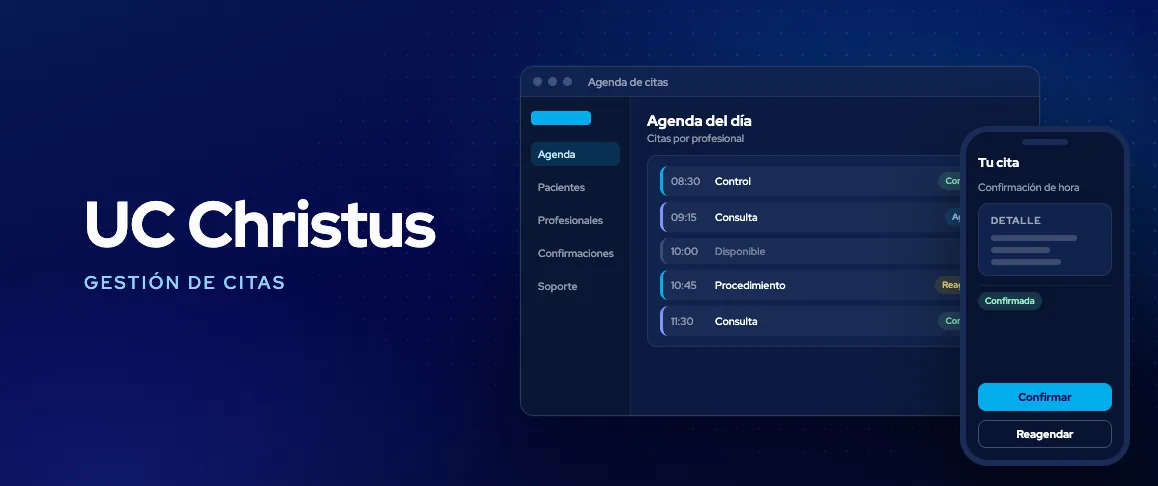
UC Christus is a healthcare institution. Nnodes provides technical support, maintenance and evolution for some of its systems in operation.
The work consists of keeping those systems running, handling incidents and supporting their evolution, in coordination with the institution's teams.
Context
In a healthcare institution, the systems that support operations must be continuously available. A failure or a badly executed change affects the teams and the people who depend on that information.
Supporting systems of this kind requires continuity, incident response and careful changes, reviewed before they reach production.
Challenge
The challenge is changing systems that cannot stop: in healthcare, a failure affects the teams and people who rely on that information every day.
- Keep continuity: the systems must stay available while they are fixed and improved.
- Prioritize well: tell the urgent from the important when several incidents arrive at once.
- Change without surprises: every adjustment must be verifiable before it reaches users.
- Work on existing systems, understanding technical decisions made at other times and by other teams.
- Coordinate with the institution's teams, who know the operation best.
The solution
Nnodes organized support as a continuous flow with three fronts: incident response, preventive maintenance and planned evolution.
Incidents are classified by impact and handled by that priority, in direct communication with the institution's teams until they are closed.
Every change follows the same path: it is developed, tested, reviewed with the responsible team and only then released. That keeps adjustments small, verifiable and reversible.
Preventive maintenance (updates, reviews and performance tuning) lowers the likelihood of failures and leaves the systems in better shape to evolve.
Incident response
Impact-based classification, prioritized response and follow-up until closure.
Controlled changes
Development, testing and review with the responsible team before every release.
Preventive maintenance
Updates and reviews to keep the systems stable.
Planned evolution
Improvements agreed with the institution and delivered in stages.
Other projects
View all
Does your organization manage critical processes with documents, deadlines or disconnected systems?
Let's talk about your operations, your current systems and where software and AI can create real impact. It all starts with a conversation.
Let's talk about your case
Tell us what you need: a new system, evolving the one you have or applying AI to your operations.