CIAL: purchase order automation for ERP integration
Processing of purchase orders, data extraction with Artificial Intelligence, validation and standardized delivery into the ERP.
Client
CIAL
Industry
Commercial automation
Focus
Purchase order automation
Result
Less manual entry and greater control before the ERP
Applied capabilities
Commercial automation
AI document processing
Master data validation
ERP integration
Exception management
Operational reporting
Executive summary
CIAL needed to reduce the manual work associated with receiving and loading customer purchase orders into their ERP.
Nnodes designed and built a platform that receives files in different formats, extracts relevant information, normalizes it into a common structure, validates products and stores against CIAL master data, shows differences to the operator and sends only orders that meet the required rules to the ERP.
The result is an operation with less manual entry, greater control over errors before they reach the ERP and better visibility into the status of each processed order.
Context
In a commercial operation with multiple customers, purchase orders rarely arrive in a single format. Some customers send PDFs, others spreadsheets, and others documents with their own structures.
When that process is handled manually, transcription errors appear, operational times increase and traceability over differences between the received order and internal master data is low.
Challenge
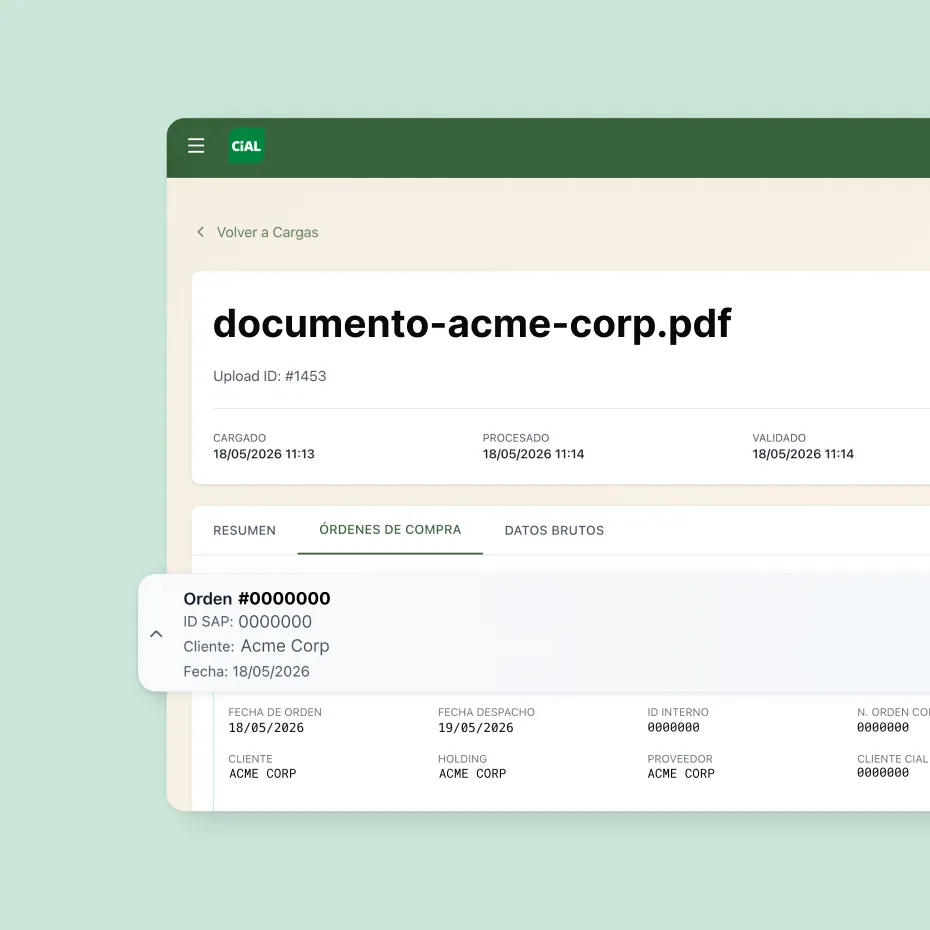
The main challenge was to build an operational layer between customer-submitted documents and CIAL's ERP system.
- Process purchase orders in different formats.
- Extract data from multiple customer formats.
- Normalize information into a common order structure.
- Validate stores and products against internal master data.
- Detect differences before sending information to the ERP.
- Record ERP responses for traceability.
The solution
Nnodes built a platform composed of three services: a user interface for operators, a business API to orchestrate the flow and a specialized document processing service.
Artificial Intelligence is used as part of a controlled flow, not as a substitute for operational validation. When known formats exist, the system can use specific parsers; when the document requires more flexible extraction, it relies on AI models to structure the information.

Less manual entry
Automatic reading and structuring of orders that previously required manual review and loading.

Control before the ERP
Validation of products, stores and extracted data before creating orders in the transactional system.

Traceability by order
Each upload, order, product, difference and ERP response is recorded for follow-up.
Multiple formats
Support for PDFs and spreadsheets, with detection of known suppliers and room for evolution.
Technical depth, in business language
The platform separates responsibilities into three components: interface, business orchestration and document processing. This separation makes it possible to add new customer formats, improve validation rules or adjust the review experience without redesigning the entire system.
The ERP integration occurs after validating extracted information against internal master data. This is key: automation not only accelerates data entry, it also creates a control point before impacting the transactional system.
Why it matters
This case shows how Artificial Intelligence can create value when it is integrated into a concrete operational process. The problem was not using AI to read PDFs; it was reducing friction in a commercial flow that connects customer documents, master data, operational exceptions and the ERP.
Relevance for other clients
The CIAL case is relevant for organizations that process documents in multiple formats, validate information against master data and need to integrate those flows with the ERP or other corporate systems.
Other projects
View all


Does your organization manage critical processes with documents, deadlines, or disconnected systems?
Let's talk about your critical processes, your current systems and where technology and AI can generate real impact.