Buses Núñez: operations platform for passenger transport
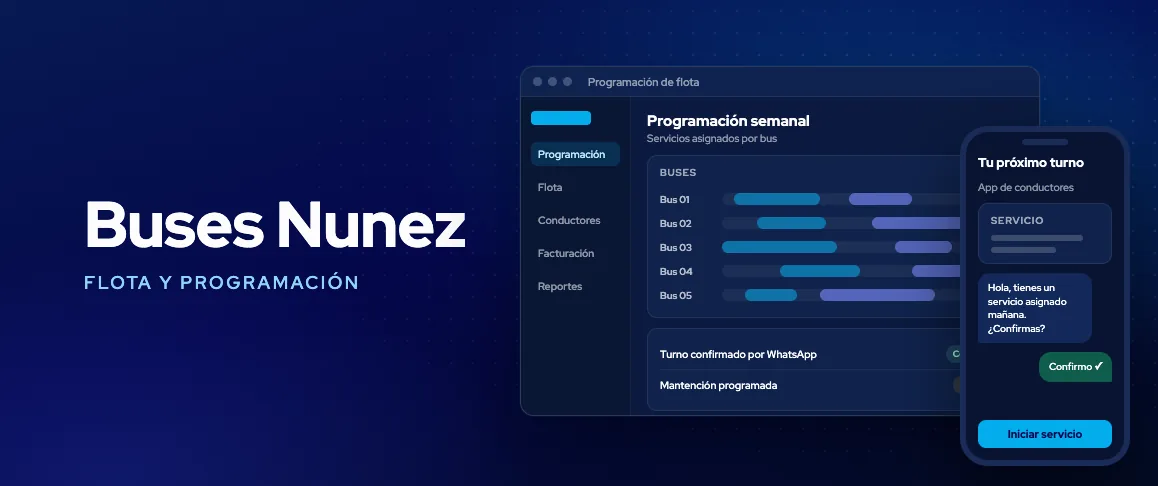
Scheduling, fleet and billing platform, with a driver app and WhatsApp shift confirmation.
Client
Buses Núñez
Industry
Transport
Focus
Scheduling, fleet and billing
Result
Shifts confirmed without calling each driver, and billing based on services actually run
Applied capabilities
Route and driver scheduling
Fleet, fuel and maintenance control
Billing of services per client
Driver app
Offline boarding kiosk
Automatic WhatsApp and voice confirmation
Executive summary
Buses Núñez provides staff transport, special services and tourism trips to companies and institutions. Coordinating vehicles, drivers, fuel, maintenance and billing in spreadsheets was slow and error-prone.
Since 2019, Nnodes has been building and evolving a platform that centralizes daily operations.
Context
Each service combines route, driver, vehicle, schedule and client. A last-minute change affects all of those pieces at once.
The company needed traffic, sales, fuel, maintenance and accounting to work from the same information.
Challenge
The challenge was to have an operation that changes by the hour, with drivers in the field and clients on different terms, work from a single version of the information.
- Absorb last-minute changes: a driver who doesn't confirm or a bus in maintenance forces routes, vehicles and people to be rescheduled at once.
- Confirm every shift on time without the dispatch team spending the day calling drivers.
- Know who boarded each bus and where, even on routes without mobile coverage.
- Bill each client for what was actually run, on their pricing terms, without rebuilding it from spreadsheets.
- Have dispatch, maintenance, fuel and accounting work from the same data, each area with its own permissions.
The solution
Nnodes designed a platform with a central system and three touchpoints with the operation: the office, the driver and the bus.
The central system holds the operating model (routes, services, drivers, vehicles and clients) and feeds the driver app and the kiosks. Scheduling and billing rules live there, so every area works from the same information.
The driver app and the boarding kiosks are built for the field: they store records on the device and sync them when the connection returns, so a stretch without signal neither stops boarding nor loses data.
Shift confirmations run as an automatic background process: the system messages over WhatsApp, retries, calls if there is no answer and, if nobody confirms, escalates the case to the dispatch team. Billing is generated from the services actually run, not from a separate spreadsheet.
Central system
Routes, scheduling, fleet, fuel, maintenance, clients and billing in a single model, with permissions by area.
Driver app
Assigned routes, trip start, code-based boarding and location sharing.
Boarding kiosk
A tablet on each bus that records boarding with location and works offline.
Automatic confirmations
WhatsApp, retries, automated call and escalation to the dispatch team.
Related solutions
Other projects
View all

Does your organization manage critical processes with documents, deadlines or disconnected systems?
Let's talk about your operations, your current systems and where software and AI can create real impact. It all starts with a conversation.
Let's talk about your case
Tell us what you need: a new system, evolving the one you have or applying AI to your operations.